


Book Review: War and Peace

Mar 18, 2026
Seoyeon Kim
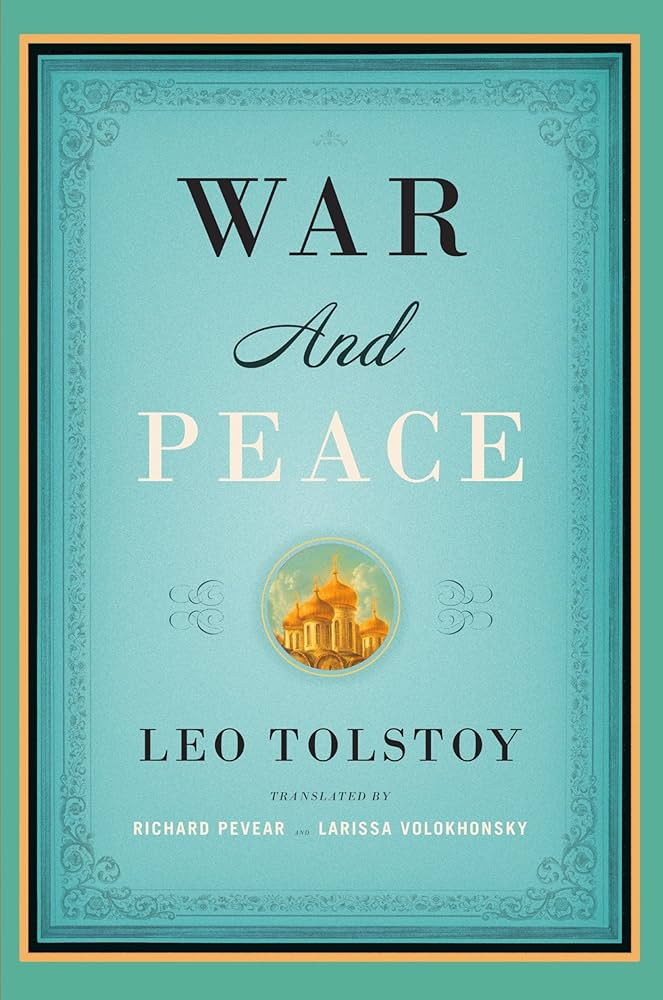
If I had to describe War and Peace by Leo Tolstoy in one sentence, I would say it feels less like reading a story and more like living inside a world that refuses to simplify itself.
This novel is set during the Napoleonic Wars, especially around Napoleon’s invasion of Russia, but calling it just a historical novel feels almost misleading. Yes, there are battles, political tension, and appearances from figures like Napoleon Bonaparte and Alexander I of Russia, but the real focus is on people. Their thoughts, their contradictions, their quiet changes over time.
What stood out to me the most is how real the characters feel. Pierre does not suddenly become wise. Andrei does not follow a clean heroic arc. Natasha is not written as a perfect heroine. They all make confusing, sometimes frustrating choices, and that is exactly why they feel human. Tolstoy seems less interested in dramatic plot twists and more interested in how people grow slowly, almost invisibly, through everyday experiences. There are moments where nothing major happens, but somehow those moments feel just as important as the big historical events happening in the background.
At the same time, this book can be exhausting. The length is not just long for the sake of being long. It is dense. There are so many characters, and many of them have similar names, which can get confusing quickly. Sometimes you feel fully immersed in a character’s emotional world, and then suddenly the novel shifts into a completely different perspective or setting. That constant shifting can either feel rich or overwhelming depending on your mood.
Another thing that might surprise you is how often Tolstoy steps away from the story to explain his own ideas. He goes deep into his thoughts about history, especially his belief that history is not controlled by powerful individuals but by countless small actions of ordinary people. It is an interesting perspective, but the way it is presented can feel heavy. Just when you are emotionally invested in the story, the narrative pauses and turns into something closer to a philosophical essay. For some readers, that adds depth. For others, it breaks the flow.
I also noticed that the novel focuses heavily on the lives of the upper class. While this makes sense given the setting, it creates a somewhat narrow lens. You see a lot of salons, conversations, and personal struggles within aristocratic families, but less of everyday life outside that circle. It makes the world feel detailed but not completely balanced.
Still, there is something undeniably powerful about this book. It does not try to entertain in a simple or easy way. Instead, it asks you to sit with complexity. It shows that life does not follow a clear structure, that people are inconsistent, and that meaning is often found in small, quiet moments rather than dramatic victories.
Reading War and Peace is not always enjoyable in the usual sense. There are parts that feel slow, repetitive, or even frustrating. But at the same time, it leaves a lasting impression in a way that few books do. It is the kind of novel that stays in your mind, not because it was easy, but because it felt real.
So in a neutral sense, I would say this. It is a masterpiece, but not an easy one. It is deeply rewarding, but only if you are willing to be patient with it. And whether you end up loving it or struggling through it, it is almost impossible to ignore once you have experienced it.


